Earlier this year, we calculated different ways of calculating CO2 emissions from air transport (link), and in these news we also discussed the so-called condensation trails effect, which is additional impacts (radiative forcing) on global warming to a greater extent than just the CO2 emitted from aircraft engines. The climate impact is exacerbated by the fact that emissions occur at high altitudes, by the formation and impact of condensation streaks, water vapor, NOx emissions, soot particles and sulfur dioxide. All these factors contribute (although some of them counteract each other) to CO2 emissions being multiplied by at least a factor of two in order to capture the full effect… and that seemed like a reasonable assumption until now (as it was about a factor of two most of our sources in the aforementioned article). The UN’s climate panel IPCC has so far assumed that one should multiply by a factor of two or three, which also testifies to uncertainty about the subject.
But in September 2020, the EU aviation agency EASA finally released an alarming update to these additional impacts, and it now turns out that we should actually multiply emissions by a factor of three – and not just two. EASA points out that it has become wiser in the field over the last ten years.
And we listen to institutions that become wiser; we listen to the IPCC and the EU, and this means that we have to raise our estimate for aircraft compensation, from approx. 300 to 600 g CO2 emitted per flight kilometer in economy class (See calculations in the original news on the subject (link).
On the positive side, this report means that the European Commission now recommends introducing stricter tariffs on emissions of not only CO2 in the ETS but also on other emissions, e.g. NOx. But as action in this area takes time, we continue to plant trees today!
Thanks to all our amazing lifetime donors, the Implement Consulting Group and the Society of Lifestyle, we will plant what will correspond to an area of at least 94 acres of new forest in Uganda in 2020 and 2021.
The plantings will be organized by the foreign department of Skovdyrkerne, called the Danish Forestry Extension (DFA). The work in Uganda will be carried out by DFE´’s partner in Uganda, UTGA.
The area under consideration is located in Busia. In the West Bugwe group of Central Forest Reserves owned by the state. The area is managed by the National Forestry Authority.
The plantings will be different model plantations with native tree species. The planting must show that CO2 uptake via afforestation with local species is an option. An opportunity that will also benefit biodiversity.
The funds for the 94 hectares are distributed with 30 hectares from Grow For it’s lifetime donors for CO2 balance, 40 hectares from Implement Consulting Group and 24 hectares from Society of Lifestyle.
The 24 acres from Society of Lifestyle are a little unique. They should have been used for a planting in Nepal, but the COVID-19 situation has forced us to abandon tree planting in Nepal by 2020.
Society of Lifestyle has “lent” the 24 hectares to Uganda. This gave us a sufficiently large area. The 24 hectares will be made available to new lifetime donors, who will then purchase an ongoing project. Once we have “sold” the areas corresponding to the 24 hectares, the amount will be returned to the original planting in Nepal in 2021.
The model of companies making their established plantings available to employees and others, is actually the original basic vision for Grow For It. This model will mean that lifetime donors always buy trees that are in good growth and therefore absorb maximum CO2.
Interestingly, it was COVID-19 that caused us to now start with this model. Grow For It has thus initiated 24 hectares of afforestation in Uganda which can be acquired by new donors for lifelong CO2 balance
DFE / UTGA is preparing the project plan. We will explain in more detail about the planting, when the project plan is ready.
Så har vi en fed nyhed at dele med jer: Vi er nu blevet “Grove-partnere” hos Eden Projects (og på dansk burde det hedde “Lund-partnere”, det er ikke fordi vi er særligt grove ;-))
Det betyder, at alle jer seje donorer tilsammen har doneret for mere end 50.000 dollars! Det er vi helt ufatteligt stolte af, og i samme ombæring kan vi oplyse, at vi har modtaget donationer til plantninger helt til oktober i år, så det er meget flot!
50.000 dollars sikrer plantning af mere end en halv million træer, det vil sige cirka 1.000 tons co2 fjernet årligt, og det betyder også, at vi er i selskab med kæmpevirksomheder som den amerikanske internetudbyder Verizon (der er stadig et stykke vej op til de helt store organisationer som Ecosia og 10tree, som hver har doneret over 1 mio dollars).
Med vores donationer har vi sammen sikret arbejde i lokalområdet for mere end 5.000 timer svarende til knap tre fuldtidsansatte på Madagascar. Det betyder også meget for os.
Og se lige de seje træplantere i videoen, fremsendt af Eden Projects. Mere end 12 mio træer plantet i april hele verden rundt – midt i en coronakrisetid!
Hvis man gerne vil se nærmere lokation via GPS, kan koordinaterne ses på dette fine billede:
Tree plantings are also
affected by Covid-19, but because the planting periods are different the
situation is also different. Below is a description of how Covid-19 influences
plantings in Nepal, Vietnam and Uganda.
Nepal: In Nepal, the planting period is July, August
and September. Danish Forestry Extension (DFE) is confident that the local
forestry association (the same as last year) will plant all trees. Last year,
12 acres were planted. This year, 27 hectares will be planted. All 27 acres are
reserved. We have thus sold out in Nepal.
Vietnam: In Vietnam, the best planting season is
September, October and November. Danish Forestry Extension (DFE) likewise
believe that the local forestry association will be able to plant within the
period, especially because the period is late in the year. Last year, 14 acres
were planted. This year, the local forestry association has asked for assistance
to plant 20 acres. We have not yet sold out of plantings in Vietnam. Read about
the Vietnam model here https://growforit.dk/modeltraeplantning-i-vietnam-er-nu-faerdig/
Uganda: In Uganda, the country is influenced by
Covid-19. All non-essential public institutions have been shut down, including
the National Forestry Authority (NFA). Therefore, the local forestry
association, UTGA, is at a stand-still regarding the “land lease” we
should have planted on in 2020. Unfortunately, this uncertainty means that we
will not be able to complete a spring planting during the period March, April
and May. We are instead aiming for UTGA and Danish Forestry Extension (DFE) to
be able to get a response from NFA, so we will be able to plant in the autumn
period running from September to November.
Last year in Uganda, we
planted 50 hectares with TROFACO. In 2020, we expect to be able to plant a
similar area. This time, it will be with Danish Forestry Extension and the
local forestry association UTGA. 27 acres of the 50 acres are reserved. Thus,
we still have not sold out in Uganda.
Madagascar: In Madagascar, planting is continuously
occurring, as the locals themselves produce and handle the mangrove cuttings
that they also plant themselves. And because mangrove trees grow in salt water,
there is no specific rain season to consider.
We have begun calendar year 2020 and it is with good news and fresh pictures from Madagascar!
In 2019 we planted a total of 34 hectares of mangrove forest, some of which can be seen in the pictures above. We are very proud of that achievement.
The picture on the left shows the wetland where the mangrove trees are planted. In the picture on the right you can see how the soil in some places needs trees with strong roots to alleviate erosion – for this the mangrove trees play their part.
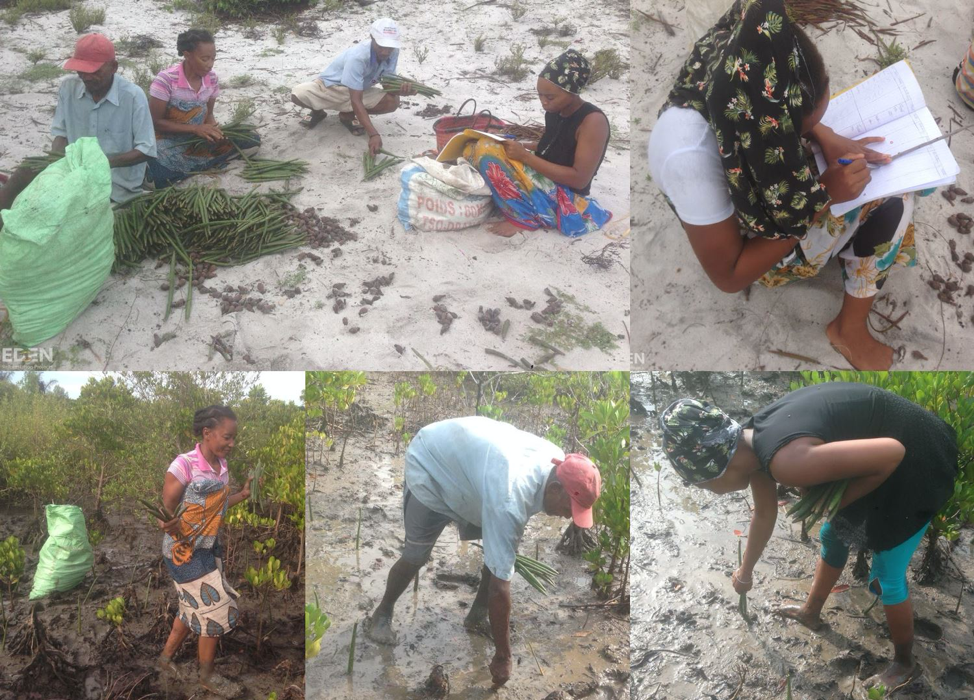
Eden Projects document the work by taking pictures, so we can keep an eye on this at a distance (we are very satisfied with this agreement!). The photos above are from October as it takes some time to get the photos from the field back to Eden Project’s local headquarters in Mahajanga.
Som det kan ses på billederne herunder, benytter man (udover fotografens kamera 😉) den teknologi, man har til rådighed – dvs. ingen high tech waders eller tablets – og det vil også sige, at donationerne går fuldstændigt til træplantning, ikke til teknologileverandører eller andet godtfolk. Vi er i sandhed i gang med at starte noget nyt og stort op på Madagascar!
And as can be seen in the pictures below, you use (besides the photographer’s camera) the technology you have available – i.e. no high tech waders or tablets – and that means that the donations go fully to tree planting, and not to technology providers or other good people. We are indeed starting something new and big on Madagascar!
When the images arrive at headquarters, they are sent to the Eden Project department in the United States (unless cyclones or other terrible weather render the internet connection difficult – and they have had plenty of terrible weather over the past few months). In the US, the images go through an approval process and then they can be passed on to us. But it is all worth the wait – we really appreciate Eden Projects as a transparent and reliable partner in tree planting.
And last but not least, we’ve just asked Eden Projects to increase the volume from four to five acres per month so at present we expect to plant a total of 60 acres in Madagascar by 2020.
Mangrove forest in Madagascar with Eden Projects status update
by Peter Esmann | 20. November 2019
Since August we have doubled the number of hectares from 2 to 4 hectares per month, from 20,000 to 40,000 mangrove cuttings a month at the Antsanitia site – see pictures of the new mangrove cuttings here.
Shortly after we signed the doubling agreement, our donors had paid in such large sums that our enlargement was close to oversubscribed. We have now added an addition to our agreement with Eden so that in future we can increase the plantings if you, dear donors, again help to over-fulfill the agreement. Following the 2019 enlargements, the goal is that Grow For It will continue to plant 4 hectares of mangrove forest by 2020 – every month!
Together with the expansion, we were allocated an area which is exclusively for Grow For It. The location means that the local people who plant the mangrove cuttings do not have to go that far every day, and as the area is pre-defined (121 hectares) we also know when we have filled the entire area with mangrove trees. This link provides GPS marking of where Grow For It’s part of the Antsanitia site is located (see also the area boundary on the 121 acres below).
This summer, we received new photos from Eden Reforestation Projects from the 18-acre mangrove Ampazony site in Madagascar, which was planted in 2018 with $200-donations, GO-FOR-IT-packages and 300 corporate gifts (more here). Debbie from Eden Projects wrote the following:
I also wanted to share some update photos from the Ampazony site. The photos in this folder show the progress on some of the earliest planted trees and additional planting in areas that needed to be filled in after the initial planting. The trees that are now over a year old look amazing!
For those who do not know, mangrove forest grows and acts as a kind of nursery for life in the coastal zone, with the roots providing perfect hiding places for small fish. At the same time, the mangrove trees protect ecosystems from storms and waves. The function of the mangrove trees is really well explained here in this video.
Shortly after we signed the doubling agreement, our donors had paid in such large sums that our enlargement was close to oversubscribed. We have now added an addition to our agreement with Eden so that in future we can increase the plantings if you, dear donors, again help to over-fulfill the agreement. Following the 2019 enlargements, the goal is that Grow For It will continue to plant 4 hectares of mangrove forest by 2020 – every month!
Efter udvidelserne i 2019 er målet, at Grow For It i 2020 vil fortsætte med at få plantet 4 hektar mangroveskov – hver måned!
I forbindelse med udvidelsen af aftalen blev vi også tildelt et areal, som kun er til os i Grow For It. Placeringen gør, at de lokale folk, som planter mangrovestiklingerne, ikke har så langt hver dag.
Den klare afgrænsning af arealet (121 hektar) betyder også, at vi ved, hvornår vi har udfyldt hele området med mangrove træer. Dette link giver en GPS markering af, hvor Grow For Its del af Antsanitia-sitet ligger (se også areal-afgrænsningen på de 121 hektar nedenfor).
This summer, we received new photos from Eden Reforestation Projects from the 18-acre mangrove Ampazony site in Madagascar, which was planted in 2018 with $200-donations, GO-FOR-IT-packages and 300 corporate gifts (more here). Debbie from Eden Projects wrote the following:
I also wanted to share some update photos from the Ampazony site. The photos in this folder show the progress on some of the earliest planted trees and additional planting in areas that needed to be filled in after the initial planting. The trees that are now over a year old look amazing!
For those who do not know, mangrove forest grows and acts as a kind of nursery for life in the coastal zone, with the roots providing perfect hiding places for small fish. At the same time, the mangrove trees protect ecosystems from storms and waves. The function of the mangrove trees is really well explained here in this video.